OWASP Agentic Top 10 with N2SF × LLM Gateway × AI DLP Security Architecture
OWASP Agentic Top 10과 함께 보는 N2SF × LLM 게이트웨이 × AI DLP × Agentic AI 보안 아키텍처
· FlowGuard AI Research · research
A comprehensive security architecture combining OWASP Agentic AI Top 10, N2SF principles, LLM Gateway, and AI DLP for controlling AI agent behavior in enterprise environments.
OWASP Agentic AI Top 10, N2SF 원칙, LLM 게이트웨이, AI DLP를 결합한 종합 보안 아키텍처로 엔터프라이즈 환경에서 AI 에이전트 행동을 통제합니다.
# OWASP Agentic Top 10 with N2SF × LLM Gateway × AI DLP Security Architecture
The generative AI era has already moved beyond "throwing prompts and receiving answers" to the **Agentic AI era** where AI sets its own goals and executes them autonomously. This change has fundamentally altered the nature of security, and OWASP has recognized this by releasing the Agentic AI Top 10 risk framework.
Moving away from traditional application security, this is why we now need:
> **Security architecture designed not around "what AI can do" but around "what we allow AI to do"**
## Architecture Goals
This reference architecture simultaneously satisfies:
- ✅ Allow AI utilization within internal networks (N2SF standards)
- ✅ Central control of communication with external LLMs
- ✅ Prevention of data export and sensitive information leakage
- ✅ Control of agentic AI **behavior (agency)**
- ✅ Secure audit and compliance traces
## Architecture Overview
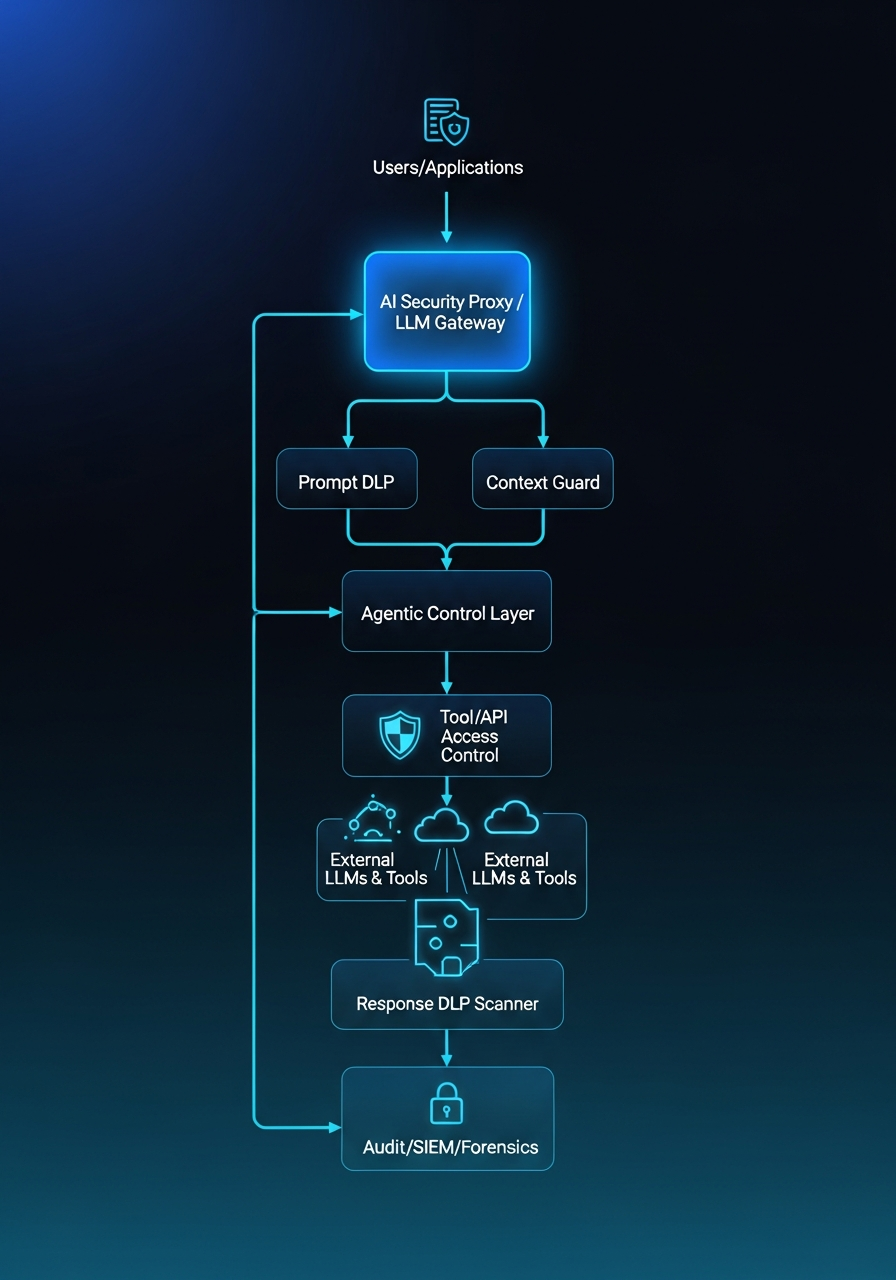
*Figure: N2SF × LLM Gateway × AI DLP × Agentic AI Integrated Security Architecture*
**Key Architecture Components:**
- **User/Application Layer** → AI requests and tasks originate here
- **AI Security Proxy / LLM Gateway** → Centralized control point for all AI communications
- **Prompt DLP & Context Guard** → Pre-processing filters for sensitive data and context validation
- **Agentic Control Layer** → Policy-based supervision with goal and behavior constraints
- **Tool/API Access Control** → Secure external tool and data access management
- **Response DLP** → Output filtering and data loss prevention
- **Audit/SIEM/Forensics** → Comprehensive logging and compliance tracking
## Component Descriptions
### 1) AI Security Proxy / LLM Gateway
- Concentrates all external LLM calls through a centralized hub
- Authorized connection point from N2SF network separation perspective
- TLS Termination, authentication/authorization, centralized API key management
- Blocks direct external access from internal accounts
- Supports standardized communication protocols (e.g., MCP, A2A)
- LLM-agnostic design (GPT, Claude, Gemini, etc.)
👉 **The only exit where allow/block policies are consistently applied**
### 2) Prompt DLP (Input Data Protection)
- Detects internal information (PII, confidential data)
- De-identification/masking/summarization processing
- Immediate policy-based export decision
- Risk scoring by user/organization
OWASP Top 10 also addresses prompt input manipulation as a key risk.
### 3) Agentic Control Layer (Behavior Supervision Engine)
Unlike simple input-output models, Agentic AI has planning, tool calls, state, and memory.
This layer handles:
| Control Item | Description |
|--------------|-------------|
| Goal Guarding | Verify submitted goals are within policy and allowed scope |
| Tool Control | Approve external tool calls (AWS, GitOps, DB, etc.) |
| Memory Sanitization | Inspect agentic memory context for contamination |
| Session Isolation | Safe context separation by task/user |
This layer technically implements the "behavior-level risk" approach emphasized by OWASP.
### 4) Response DLP (Output Safety)
When service responses flow directly into internal systems, risks arise there too:
- Automatic detection of responses containing sensitive information
- Malicious code inclusion determination
- Blocking unsafe operation results
Results generated by AI also need control before execution as internal operations.
### 5) Audit & Forensic Logging
One of N2SF's core principles is **Accountability**.
From a security audit perspective, the following are logged:
- Requester information
- Input/output data hashes
- Policy application results
- Action details (tool calls, actions)
- Time, location, result codes
This data is essential for incident response, regulatory compliance, and internal audits.
## OWASP Top 10 for Agentic AI Architecture Mapping
OWASP Agentic Top 10 risk categories directly correlate with this architecture's defense components:
| OWASP Risk | Corresponding Architecture Component |
|------------|--------------------------------------|
| Goal Hijack | Goal Guarding (Agentic Control) |
| Tool Misuse | Tool Control Layer |
| Identity Abuse | Gateway IAM / Token Separation |
| Memory Poisoning | Memory Sanitization |
| Insecure Inter-Agent Communication | Secure Messaging / Audit |
| Cascading Failures | SLO/Fail-safe / Isolation |
| Rogue Agents | Human-in-the-loop & Kill-switch |
This mapping is not just a risk list but a **behavior-control-based security design**.
## Additional Considerations for Public/Financial Sectors
### ✔ Regulatory Compliance
- Alignment with Privacy Act, GDPR, PII handling policies
- Log retention and consent-based processing for external ML calls
### ✔ Zero Trust & Identity
- Short-lived tokens and MPC-based authentication instead of static keys
- Role/Capability-based permission separation
### ✔ Runtime Security
- Action-level policy application at the application layer
- Runtime tool calls always pass through verification engine
## Practical Implementation Steps
1. **Create AI Catalog**
- Which AI/agents use which data and tools?
2. **Define Data Classification/Sensitivity Policies**
- Categorize export allow/disallow conditions
3. **Build AI Gateway**
- MCP/A2A support, policy engine integration
4. **Apply DLP Pipeline**
- Integration with Prompt/Response DLP
5. **Design Agentic Control Rules**
- Least Authority / Human-in-the-loop design
6. **Integrate Audit/Metrics/SIEM**
- Include trace logs in security operations system
## Conclusion
Security in the Agentic AI era is no longer "input value filtering."
> **Architecture that designs and controls AI's action scope (Agency) IS the security architecture.**
This architecture combines OWASP's risk model, N2SF's network/information control philosophy, and AI DLP/LLM Gateway concepts into a single **operations-centered security framework**.
**AI security is no longer optional—it's an operational necessity.**